NYC Repipe & Repair handles repiping in Brooklyn for the borough's brownstones, limestones, frame rowhouses and brick two-families, and finds and fixes the leaks that usually come first. Most Brooklyn houses were built before 1940, and many still run on their original galvanized steel or lead. Every job is copper, the material the NYC Plumbing Code requires, filed in DOB NOW and priced in writing before a wall is opened.
What repiping in Brooklyn actually involves
Brooklyn's repiping problem is mostly a question of age. City property records show 74% of the borough's one- to four-family lots were built before 1940, and 19% before 1910. That covers the brownstone and limestone rows of Park Slope, Bedford-Stuyvesant, Crown Heights, Fort Greene and Clinton Hill, built from the 1870s to the 1910s, and the brick semi-detached two-families of Bay Ridge, Bensonhurst and Dyker Heights from the 1920s and 30s. Those houses were plumbed in galvanized steel and lead, and very few have had the supply side replaced since. DOB NOW permit filings show more than 400 Brooklyn water-pipe repipe jobs since January 2023. They're concentrated in Crown Heights, East Flatbush, Bay Ridge, Bed-Stuy and Carroll Gardens.
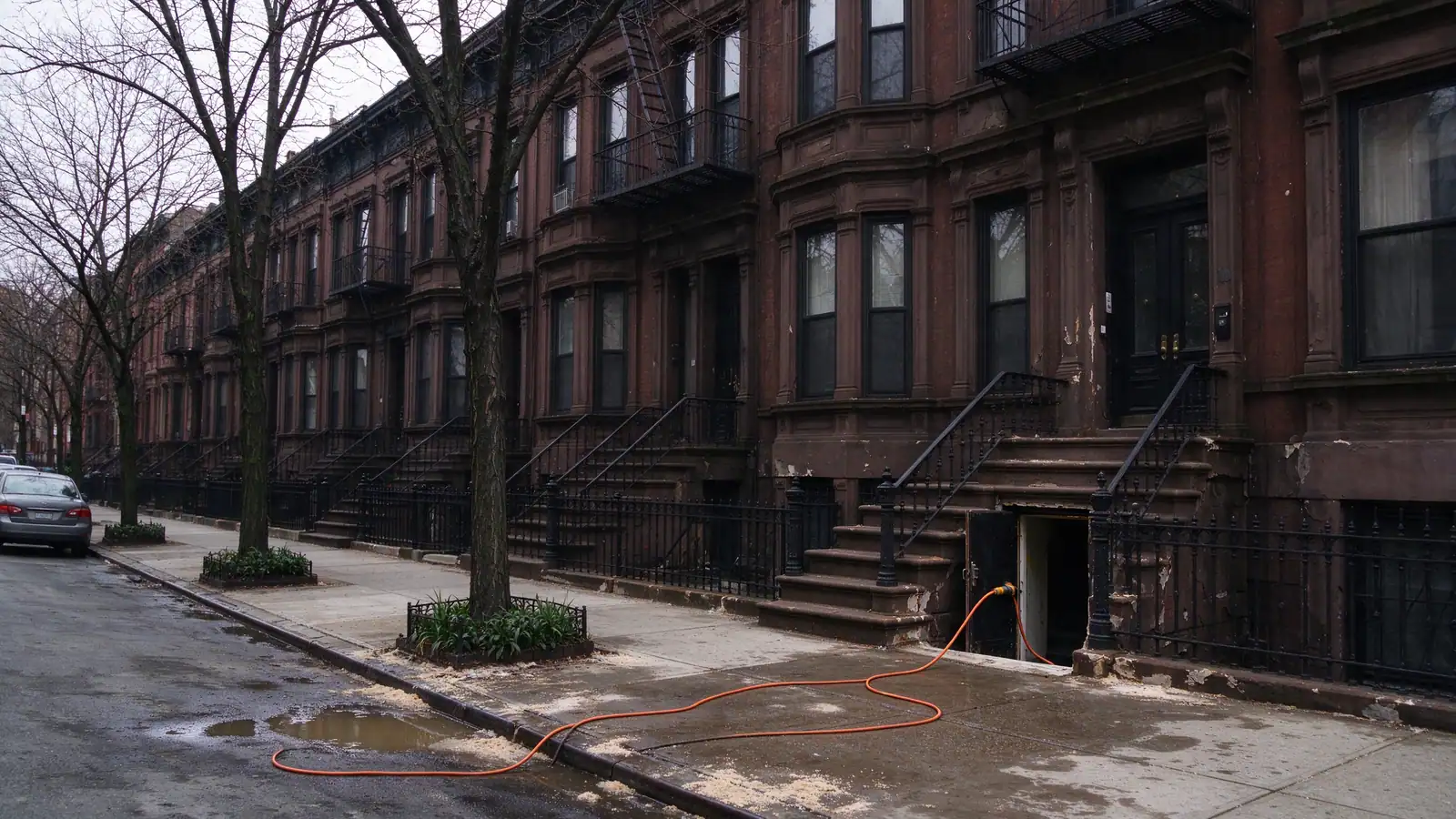
A brownstone repipe has its own geometry. The water service usually enters the cellar under the front areaway or stoop, passes the meter, and climbs four stories to a parlor-floor kitchen and bathrooms stacked at the rear. Every 2.31 feet of rise costs 1 psi of pressure, so a top-floor bathroom about 40 feet above the meter starts roughly 17 psi down before rust narrows the pipe. Modern pressure-balancing shower valves need at least 20 psi to work (NYC Plumbing Code Table 604.3), which is why the top-floor shower fails first. Walls are usually plaster on lath, so copper is routed through closets and stacked chases and each opening is cut square for a clean patch. In the historic districts, including Park Slope, Fort Greene, Clinton Hill, Brooklyn Heights and Stuyvesant Heights, permitted interior plumbing generally needs a Landmarks Preservation Commission Certificate of No Effect as well.
Further south and east the house stock changes, and so does the job. Flatbush and Ditmas Park have Victorian frame houses with long uninsulated runs along outside walls, which is where January freeze-ups split old galvanized pipe. The two-families of Bensonhurst, Sunset Park and East Flatbush often share one service line between two units, so the plan keeps one apartment on water while the other is switched over. When the street-side service line is replaced as well, the job adds a DOT sidewalk permit and DEP's service-line rules. That work is staged from the curb, with the truck on the block for the day, which on alternate-side streets in Greenpoint, Williamsburg and Bushwick takes planning.
What goes wrong in Brooklyn houses
Original galvanized in a 1900s house. Brown water first thing in the morning and a top-floor shower that never recovers. Galvanized pipe rusts shut from the inside.
A lead line under the stoop. Lead service lines were legal in NYC until 1961, and the owner owns the whole line from the street main. Many Brooklyn houses still have one.
A leak into the unit below. In a two-family or a converted brownstone, one failed joint upstairs means a stained ceiling and a tenant call downstairs.
Repairs that keep coming back. A third pinhole or thread leak in a year means the pipe has failed, not the joint. Patching moves the leak to the next weak spot.