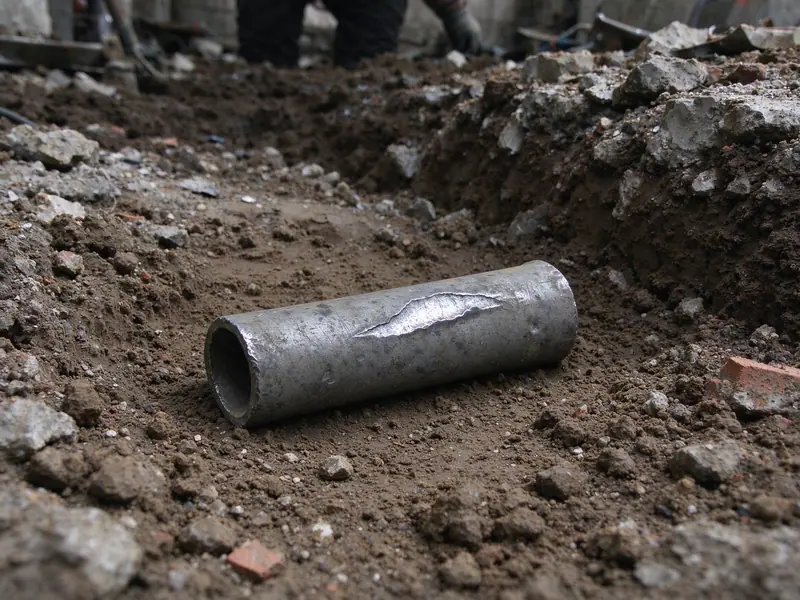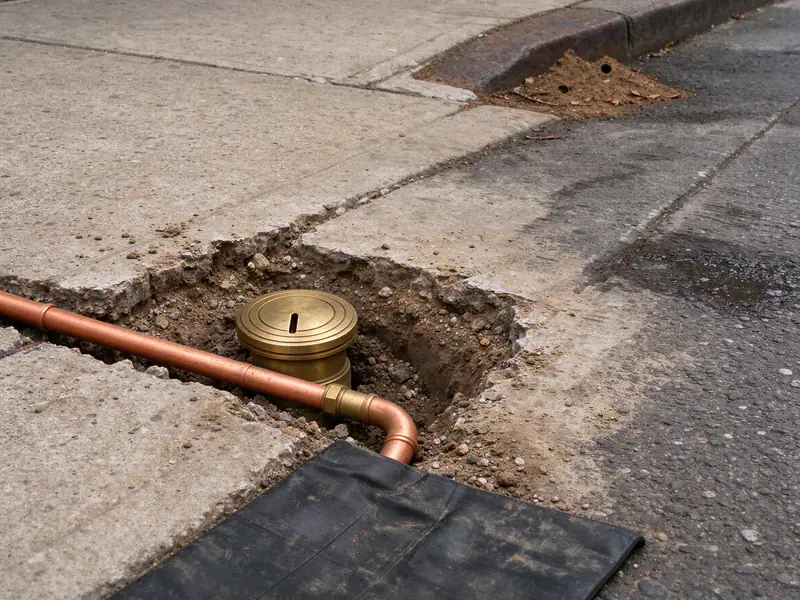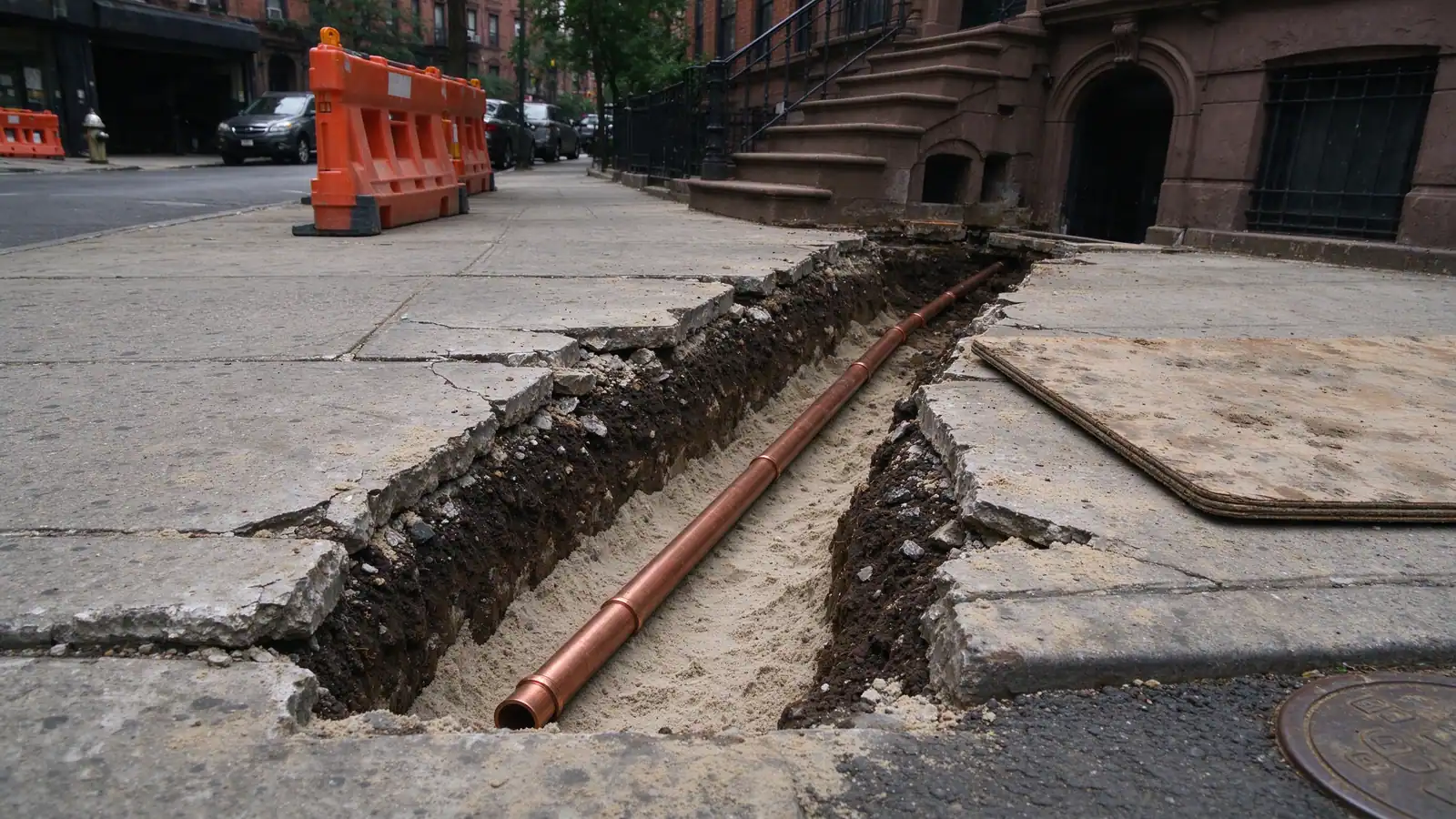
NYC Repipe & Repair replaces lead service lines in New York City: the pipe that runs from the city water main under the street, past the curb valve, to the meter inside the building. In NYC the property owner owns that entire line, including the part under the sidewalk. Lead service line replacement removes the largest single run of lead between the main and your tap. If DEP has sent you a letter about its free program, start there. If not, DEP's own plan puts a private replacement at $5,000 to $10,000.
What happens on the first visit
- The service line identified where it enters the building, and checked against the NYC Service Line Map.
- The route measured from the meter to the curb valve and the main, including any stoop, areaway or finished basement in the way.
- A check for galvanized or lead inside the house, and whether the old service is used as the electrical ground.
- A written, itemized price covering the DEP and DOT permits, the excavation, Type K copper and sidewalk restoration, before anything is booked.
Who has a lead service line, and who owns it
A service line is the pipe that brings water from the city main under the street into the building. In New York City, plumbers could legally install lead service lines until 1961, and patch repairs to existing lead lines were allowed until 2009. Lead lines are usually 2 inches or smaller, so they turn up in buildings with fewer than six units, most often older one- to four-family houses.
The DEP lead service line plan counts about 121,000 service lines that are lead or galvanized requiring replacement, plus about 118,000 of unknown material. Every known lead line is privately owned. DEP’s program page puts it plainly: property owners own and are responsible for their service line in its entirety, including the stretch under the sidewalk and street.
To check your own address, search the NYC Service Line Map linked from the DEP program page, then look at the pipe where it enters the building before the meter. How to tell if you have lead pipes in NYC shows what lead, galvanized and copper look like at the meter.
The free DEP program: who qualifies
DEP replaces lead service lines with copper at no cost, but only for eligible owners. You qualify if you receive a letter from DEP, or if the Department of Design and Construction contacts you during water main work on your street. You can’t sign up without one of those. The program started in Bronx neighborhoods including Concourse, Kingsbridge Heights, Melrose, Mott Haven and Fordham; Flushing and Borough Park are the next phases. A New York State announcement reports more than 900 Bronx and Queens homeowners helped so far, with galvanized service lines covered as well as lead.
If you get the letter, take it. DEP says replacement takes about one to two days, and its plan notes that only 63% of eligible owners have accepted. Free lead pipe replacement in NYC covers sign-up and what happens if you miss the window.
How a private replacement works
Owners outside the program hire a NYC Licensed Master Plumber, and the job crosses three agencies. Under PC 605.3, water service pipe must meet DEP’s rules, not just the plumbing code table. PC 106.6 adds DEP permits for the water connection and DOT permits for opening the sidewalk and street (2022 NYC Plumbing Code, ch. 1). Inside the property line, buried water pipe is limited to Type K copper, brass, ductile iron or stainless steel (Table 605.4.1), and Type K copper is the usual choice for a residential service. Type L vs Type K copper explains the difference in wall thickness.
The work itself runs in this order: permits and a DEP shutoff are arranged; the sidewalk and street are opened at the main and the curb valve; the new Type K copper is run into the building, often under a brownstone stoop; it is connected at the main, curb valve and meter; and the trench is backfilled and the sidewalk restored. Afterward, the line is flushed, and an electrician checks the grounding if the old service was the ground.
What it costs, and what comes after
DEP’s plan puts a private replacement at $5,000 to $10,000 per line, and the program page warns it can cost more than $8,000. Longer runs, wider streets, deep mains and finished basements push the price up; A Good Plumber lists $5,000 to $15,000 for Brooklyn. The lead service line replacement cost guide breaks the line items down.
A new service line fixes the pipe outside the meter, not the pipe inside. Lead in household plumbing wasn’t banned until 1987, and a house old enough to have a lead service usually still has galvanized supply inside. If the water is brown or pressure is weak upstairs, price galvanized pipe replacement or a whole house repiping at the same time, so one shutoff and one set of wall openings covers both. For the street-side work on non-lead lines, see water line replacement. Housing-stock details are on the Bronx, Brooklyn and Queens pages.
What's included
- Type K copper service pipe from the main to the meter
- Connection at the main, curb valve and meter
- DEP and DOT permits for the connection and sidewalk opening
- Work filed by, or done under, a NYC Licensed Master Plumber
- Lead-free valves and fittings certified to NSF 372
- Excavation, backfill and sidewalk restoration
- Flushing of the new line before it goes into use
- Grounding check flagged for the electrician where needed
Not sure whether the pipe at your meter is lead? One look and a scratch test settles it. (929) 659-6658