NYC Repipe & Repair replaces cast iron drain, waste and vent stacks in New York City houses and small apartment buildings: the vertical pipe that carries every toilet, tub and sink down to the house drain, and the branches that feed it. Cast iron stack replacement is the fix when the pipe has cracked, rotted through along a horizontal run, or keeps leaking at the hubs. The new stack is cast iron, or PVC where the 2022 NYC Plumbing Code allows plastic: residential buildings of five stories or fewer.
What happens on the first visit
- A camera inspection from an accessible cleanout, where there is one, to see the inside of the stack and house drain.
- Every stain, odor and slow drain mapped to the stack and branch it sits on.
- Building height and occupancy confirmed, which decides whether PC 701.9 allows PVC.
- A written, itemized price with the wall and ceiling openings marked, before anything is booked.
How cast iron stacks fail
A stack is the vertical drain and vent pipe that every toilet, tub and sink on a line drains into. In New York City houses and walk-ups it is usually cast iron, joined at hubs packed with oakum and lead, and in most prewar buildings it is original. City property records (MapPLUTO) show 74% of Brooklyn’s one- to four-family houses were built before 1940, and the Bronx has 72% of its five-plus-unit buildings in the same era. Drain pipe that old fails in a few recognizable ways:
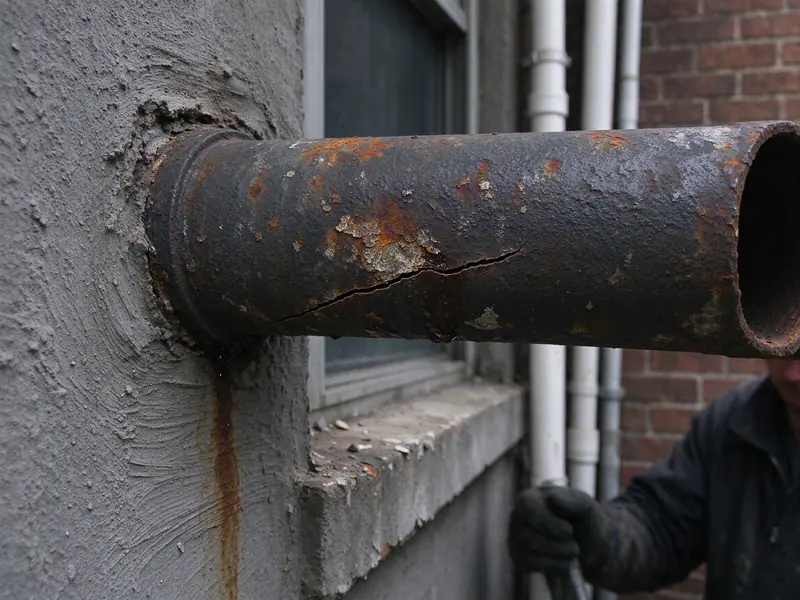
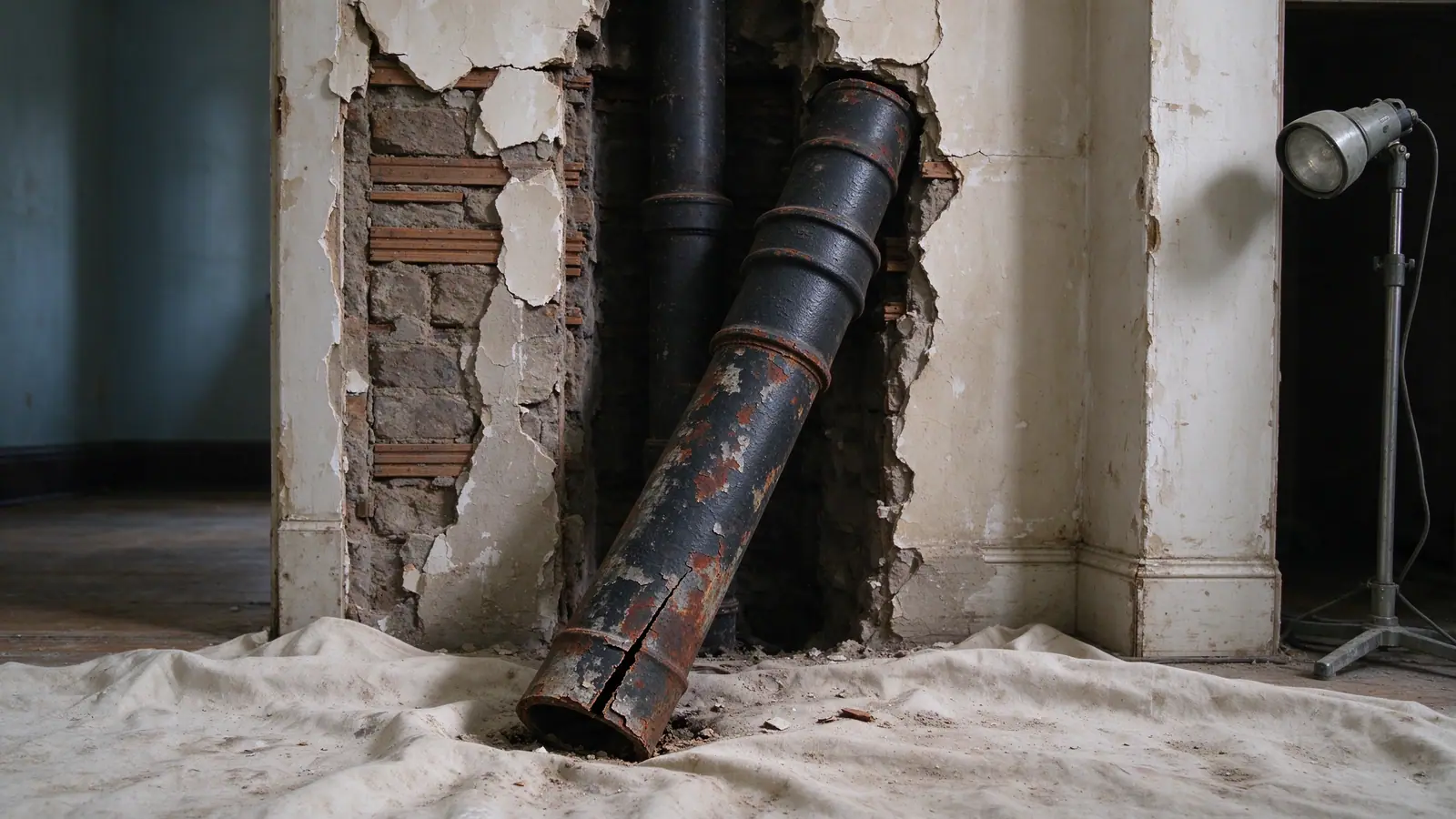
- Cracks along the length of the pipe, often on a vertical run behind a wall, showing up as a stain on the ceiling below a bathroom.
- Rot along the bottom of horizontal sections, where water and waste sit, until the pipe wears through from the inside.
- Leaking hub joints, where the oakum and lead has dried out and lets water or sewer gas through.
- Recurring clogs and slow drains, from rough, scaled interior walls or a sagging section in the cellar that holds waste.
If the leak itself hasn’t been found, water leak detection is the place to start, and a buried line under the cellar floor is covered under slab leak repair.
Cast iron or PVC: what NYC code allows
New York City limits plastic drain pipe more tightly than most of the country. Under PC 701.9 of the 2022 NYC Plumbing Code, plastic drain, waste and vent piping may be used only in residential buildings five stories or less. A brownstone, a two-family house or a five-story walk-up can take a PVC stack. A six-story apartment building, or any building outside that residential exception, stays in cast iron. Where PVC is allowed, cast iron is still worth pricing in stacked bathrooms and next to bedrooms, because it is quieter.
The same chapter rules out the shortcut. PC 701.10 states that cured-in-place pipe (CIPP) and epoxy spray lining systems shall not be used, so a lining quote for a stack in NYC is not code work. Pipe lining vs repiping explains the ban and what it means for a damaged drain.
How the job runs
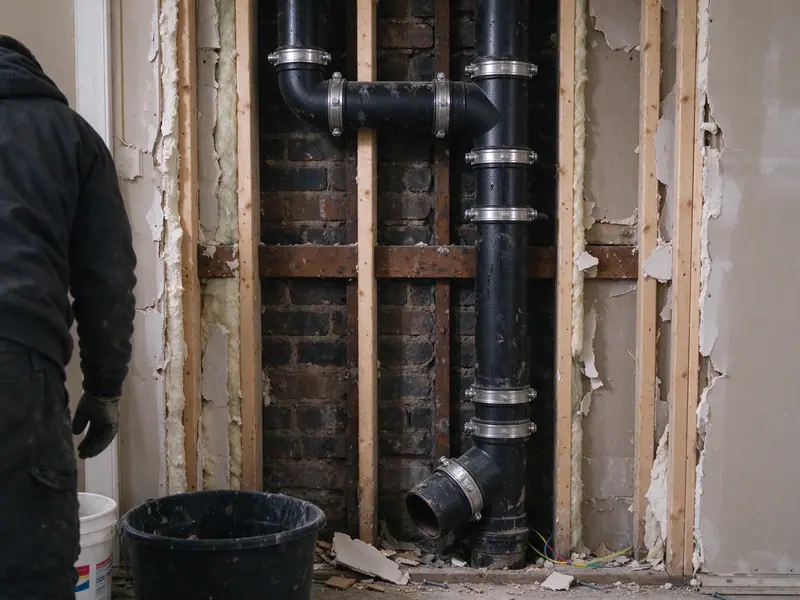
A stack is replaced in sections, usually from the top down. Each length of old cast iron is cut out, supported and removed while the pipe above and below is held in place with riser clamps, and new pipe is joined with listed couplings or hubs. Fixtures on the line are out of service while their section is open, so the work is sequenced bathroom by bathroom. Drain work doesn’t touch the water supply, so the house normally keeps running water throughout.
Openings are planned in the same chases and stacked walls a supply repipe would use. That’s why stack work and a whole house repiping are often priced together: one set of wall openings and one restoration bill covers both. The same logic applies during a renovation; see repiping during renovation, brownstone repiping and two family house repiping.
A full stack is well beyond the 10-foot limit for ordinary plumbing work, so it is filed in DOB NOW: Build by a NYC Licensed Master Plumber. The code also requires altered plumbing systems to be tested, with DOB witnessing the test (PC 108.4.1, ch. 1). The permit guide covers fees and penalties.
What it costs, and when it grows
The one published NYC figure on the drain side is $2,500 to $6,000 for a single drain branch (handyman-new-york-city.com). No NYC source publishes a sourced range for a full stack, so the estimate prices it from the site visit. The main drivers are:
- Height: number of floors, and whether PC 701.9 allows PVC.
- Access: open chases versus tiled walls and plaster ceilings.
- Fixtures: how many branches tie into the stack.
- The cellar: whether the house drain and trap under the floor need replacing too.
A stack serving multiple apartments is a building project, and in co-ops it usually belongs to the board’s capital plan alongside water riser replacement. For a house, see cast iron stack replacement cost, the Brooklyn page for rowhouse stock, or take the repipe assessment to see whether the supply side needs work too.
What's included
- Cast iron, or PVC where PC 701.9 allows it
- Listed couplings or hub joints at every connection
- Riser clamps and supports at each floor
- New branch connections for each fixture on the stack
- Vent connections carried through to the roof
- DOB NOW filing by a NYC Licensed Master Plumber
- Drainage test witnessed as the code requires
- Removal of the old cast iron from the building
A stain under the bathroom and a sewer smell you can't place? A camera down the stack shows what's cracked. (929) 659-6658