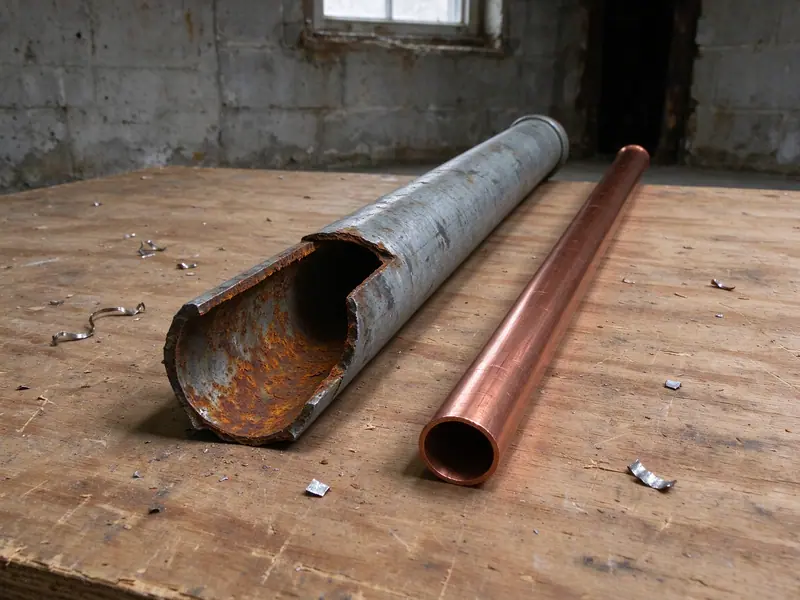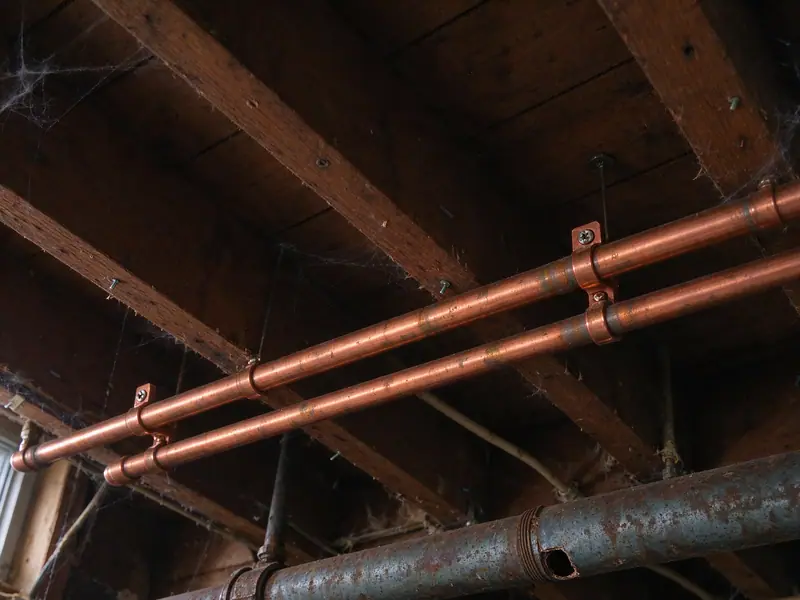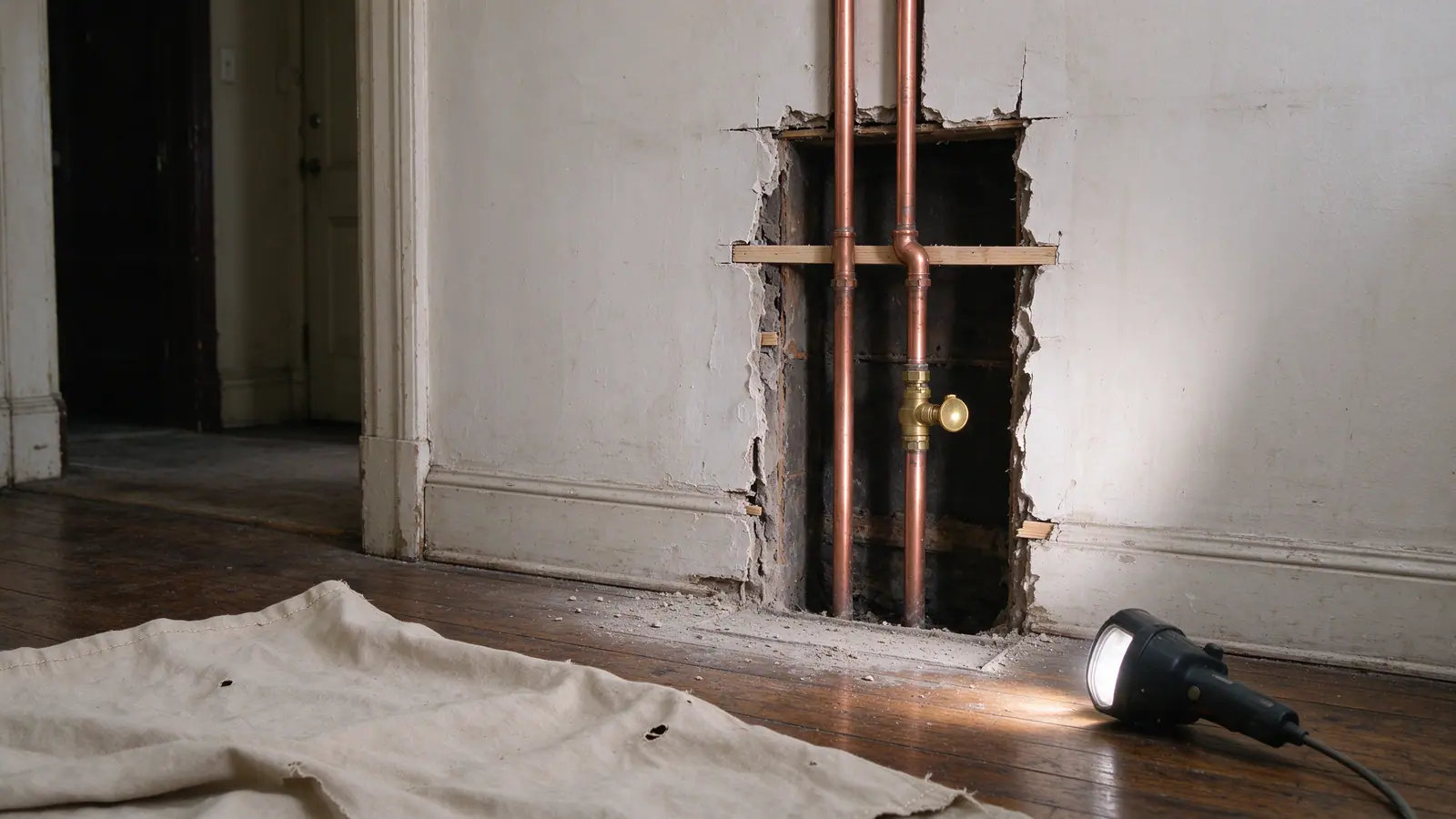
NYC Repipe & Repair replaces the complete water supply system in New York City houses: every hot and cold line from the water meter to each fixture, in Type L copper, the material the 2022 NYC Plumbing Code lists for water distribution. Whole house repiping is the right call when the pipe itself has failed, not just one joint. That means rust-colored water, falling pressure on the upper floors, or a third leak in a year. One permitted job ends the cycle of patch repairs.
What happens on the first visit
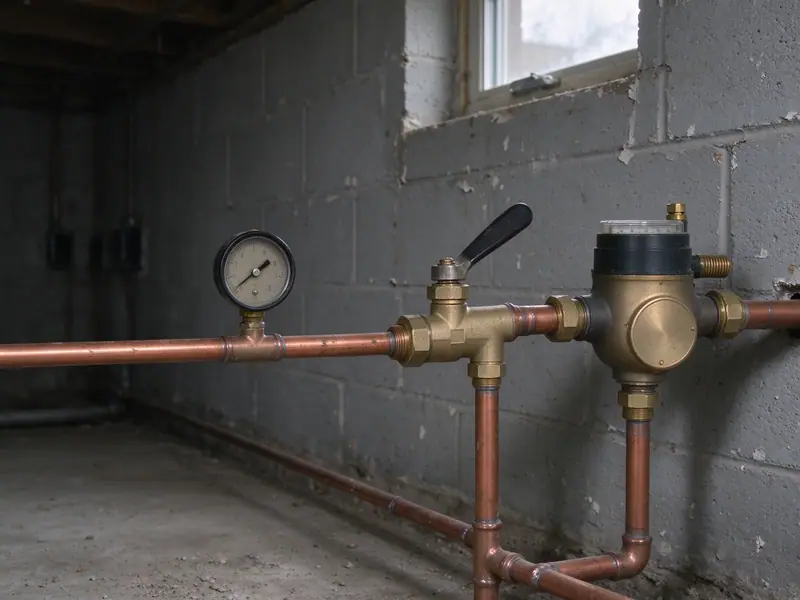
- Pressure and flow readings at the meter, the lowest fixture and the top-floor shower, so the problem is measured, not guessed.
- Pipe material identified at three or more points (galvanized, lead, brass, Type M or Type L copper) and the service line checked from the curb valve to the meter.
- A walk-through to plan pipe routes through closets, chases and ceilings, with every wall opening marked in advance.
- A written scope and fixed price, including the DOB permit, testing and the wall-opening plan, before any work is booked.
Why so many NYC houses need repiping now
Most supply pipe in New York City houses is older than the people living in them. City property records (MapPLUTO) show 74% of Brooklyn’s one- to four-family lots were built before 1940, with a median build year of 1925. Queens has a median of 1935. Galvanized steel was the standard supply pipe through that era, and published lifespans for it run roughly 40 to 60 years. A house that still has its original galvanized pipe is running decades past that.
NYC water speeds up the decline. The city’s supply is soft, averaging about 25 mg/L hardness, and it is chemically aggressive. DEP’s annual water quality report puts the average Langelier saturation index at −2.21; a negative value means the water dissolves metal rather than coating it. DEP doses orthophosphate to slow that, but it can’t reverse 80 years of internal rust. The symptoms are predictable:
- Brown or orange water after the tap has been off overnight, worst on hot water.
- Falling pressure on the top floor, because rust narrows a 3/4-inch line to the bore of a pencil.
- Leaks at threaded joints, where galvanized pipe is thinnest.
- Pinhole leaks in older copper, especially thin-wall Type M copper installed from the 1960s onward.
When two or more of these show up together, the system has failed. Patching one leak moves the pressure to the next weakest joint. Should I replace galvanized pipes? walks through repair-versus-replace in detail.
Copper only: what the NYC code allows
New York City writes its own plumbing code, and it is stricter than the codes behind most national repiping advice. Table 605.4 of the 2022 NYC Plumbing Code lists the materials allowed for water distribution inside a building: brass, copper and copper-alloy pipe, copper tubing Types K and L, ductile iron and stainless steel. PEX, CPVC, PP-R and galvanized steel are not on the list, and neither is thin-wall Type M copper.
That changes what a correct NYC quote looks like:
- The pipe is Type L copper (ASTM B88), joined by solder or by permanent press fittings made with a manufacturer-certified tool.
- Removable push-fit fittings are prohibited (PC 605.9), so a hardware-store push-to-connect repair is not code work.
- Where new copper meets old steel, the joint uses a brass fitting or an ASSE 1079 dielectric union (PC 605.24.1) to stop galvanic corrosion.
- Every fitting and valve on drinking water must be lead-free to NSF 372.
A quote priced off PEX is either not for NYC or not for a legal job. Copper vs PEX in NYC covers the code history and why Long Island and upstate rules differ.
How the job runs in a lived-in house
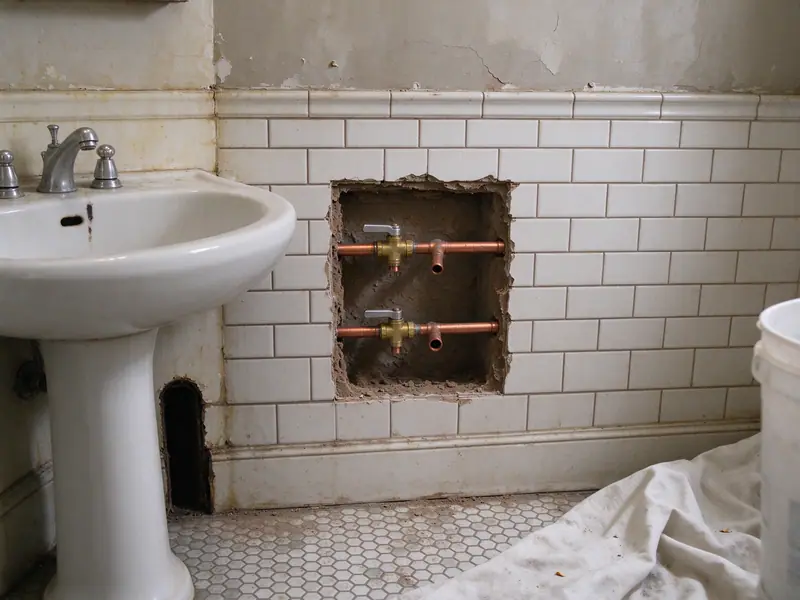
Whole house repiping doesn’t mean gutting the house. The new copper is run as a parallel system: risers go up through closets, chases and stacked bathroom walls, and branches feed each fixture through small, planned openings. The old pipe stays live until each section is switched over, so the house is normally back on water at the end of each working day.
Prewar houses add two things a national quote won’t account for. Plaster and lath is opened in clean squares rather than broken out, so it can be patched flat. And in a landmark district such as Park Slope or Fort Greene, interior plumbing that needs a DOB permit generally also needs a Landmarks Preservation Commission Certificate of No Effect. Allow several extra weeks for it before work starts.
Before any wall is closed, the new system is pressure-tested, and the permit is inspected and signed off. That sign-off is what shows up when the house is sold or refinanced. The repiping timeline guide breaks the job down day by day.
Permits, insurance and paying for it
In NYC, replacing a house’s supply piping is filed in DOB NOW: Build, usually as a Limited Alteration Application, by a NYC Licensed Master Plumber. The permit fee is small next to the job. For a one- to three-family house, DOB’s published LAA chart starts at $130 for work up to $5,000, plus $2.60 per additional $1,000. A $30,000 repipe carries a $195 filing fee. Skipping the permit costs more: the penalty for unpermitted work on a one- or two-family house starts at $520.
Homeowners insurance usually pays for sudden, accidental water damage from a burst pipe, not for replacing pipe that wore out. Repiping is generally a planned capital cost, which is why the written estimate itemizes the plumbing, the permit and the wall restoration separately. Is repiping covered by insurance? explains what adjusters look for. For prices by house type, see how much repiping costs in NYC or run your own numbers in the repipe cost estimator.
What's included
- Type L copper for all hot and cold supply (ASTM B88)
- New shutoff valves at every fixture and a full-port main valve
- Lead-free brass and fittings certified to NSF 372
- Dielectric or brass transitions where copper meets other metal
- DOB NOW permit filed by a NYC Licensed Master Plumber
- Pressure test of the new system before walls are closed
- Pipe supports and insulation where the code requires them
- Removal of abandoned pipe that can be safely reached
Brown water, weak pressure or a third leak this year? A pressure test settles whether it's a repair or a repipe. (929) 659-6658